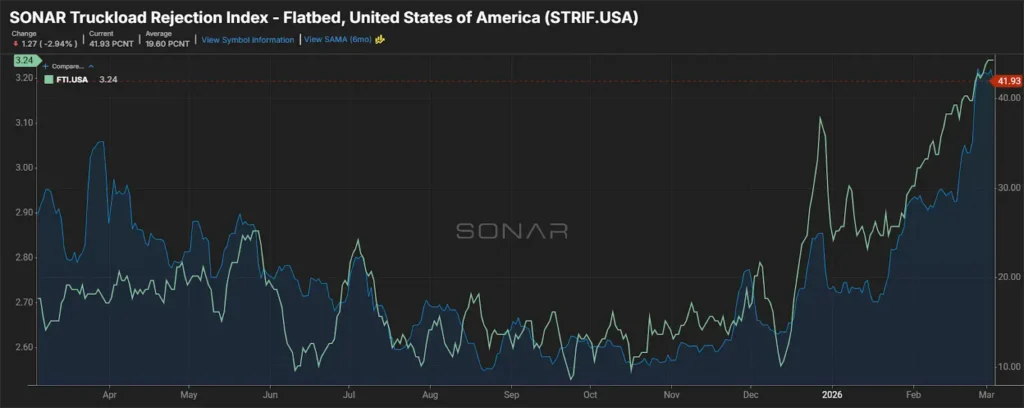
Flatbed tender rejections reached 41.93% on March 5th, per Freightwaves SONAR. That amounts to a 35.5% rise from March last year. The increase was the largest seen since the height of the pandemic.
In a related move, open deck shipping rates have also risen by 39 cents in 2026. The rise in rates tracks with what we warned of in our 2026 Outlook post. In it we pointed to the continuing trend of carrier departures and likelihood of modest to major rate increases in 2026.
So far, the needle has pointed to “major.”
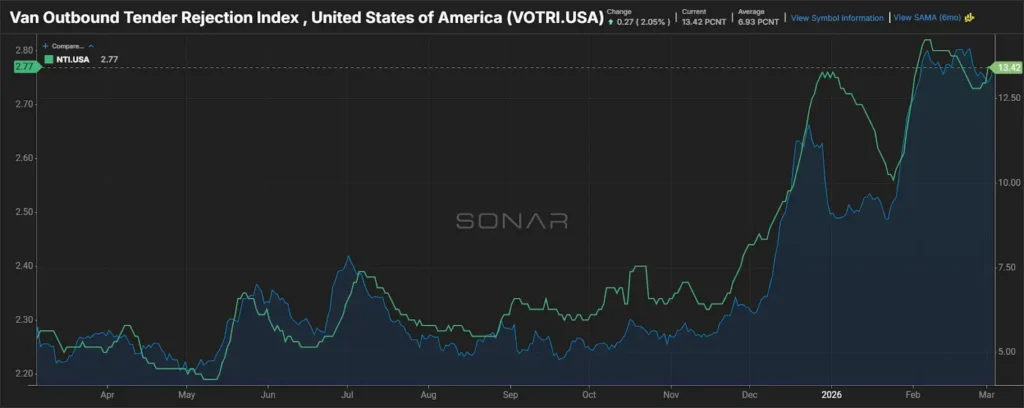
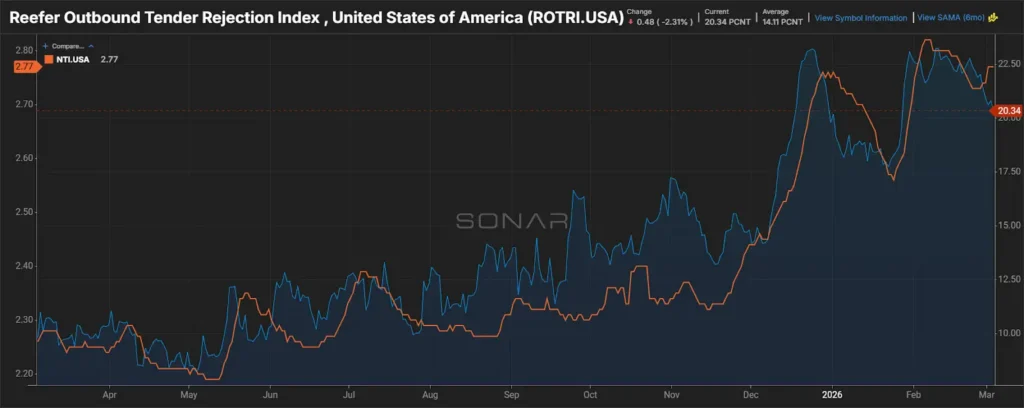
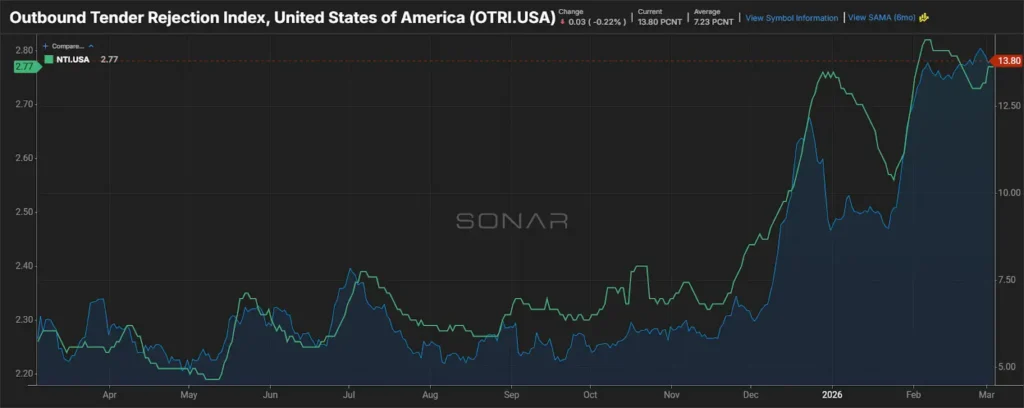
Rates have risen across the board in tanker, dry van and reefer in 2026; however the rise in tender rejections and rates was markedly higher in open deck.
Disruption ahead for open deck shippers
Shippers of oversize and overweight freight across industries face growing capacity scarcity and increasing rates in the immediate future.
Industries including heavy equipment makers, building materials manufacturers, data center equipment providers, construction companies, oil and gas companies should plan for disruption as summer starts and the seasonal demand for open deck capacity in the construction industry swells.
For the longer term, the recent spikes in open deck rates and tender rejections point to more of the same as the overall freight market undergoes a long-anticipated correction which Freightwaves recently affirmed is underway.
Our 2026 Outlook post discussed this theme and how shippers with transactional transportation models will be especially vulnerable as we move from an environment of low rates and plentiful capacity to more of a carriers’ market. Short-term contracts which may or may not be honored and reliance on a volatile spot market are the recipe for unstable times ahead for shippers.
Data center growth driving flatbed demand
Over the last few years the boom in AI-driven data center construction has quietly been gobbling up open deck capacity to the detriment of shippers of large and heavy products across the U.S.
The U.S. data center construction market currently valued at over $83 billion is expected to grow to over $154 billion by 2031, according to Research and Markets. Recently TA Dedicated has seen a major increase in demand for open deck shipping to move the power modules used in data centers. Count on this trend continuing to keep demand high.
Industrywide disruption compounds the pressure
Shippers in general face considerable disruption in truck capacity and rates ahead, and flatbed shippers will bear the brunt of industry-wide market shifts and continuing regulatory enforcement.
The rising costs of trucking and other economic challenges are driving carriers and capacity from the market. This trend continues in 2026. So far 20 carriers have filed for bankruptcy in January and February this year per Equipment Finance News.
This disruption stresses shippers generally and flatbed shippers specifically because of already-existing pressures.
Expect capacity to be impacted by regulatory enforcement
In addition to capacity removed from carrier exits, flatbed shippers need to keep a close eye on capacity erasure resulting from regulatory enforcement related to ELP and non-domiciled CDLs. An unexpected ramp-up this year will change the impact to capacity on a much larger scale than originally expected.
The Dalilah’s Law introduced in February this year, received a supportive boost during the State of the Union Address. If passed, the law could remove as many as 18-19% of CDL holders, according to Freightwaves. The total impact of this law could be the loss of over 600,000 drivers from all modes: dry van, reefer, tanker and flatbed.
The hit to capacity industrywide will be further exacerbated by the removal of thousands of non-compliant CDL training programs which will restrict the number of new drivers entering the market. In addition, greater enforcement of drug and alcohol violations will also place more drivers OOS.
Open deck shippers need to plan well
Now is the time for shippers who depend on reliable, safe open deck shipping to review their transportation strategies.
Depending on your transportation model, your options vary.
Shippers who rely on over-the-road carriers need to lock-in rates and capacity now. This however, is a limited strategy that won’t address the cycle of uncertainty ahead. That’s because contracts will be short term and as rates rise, so will tender rejections. Covering freight on a volatile spot market will only add to the uncertainty for shippers.
Private fleets with their own equipment are shielded as capacity constricts and rates rise. But other forces today undermine that advantage, namely rising costs from managing an aging fleet. This is a main reason private fleets cost 4.8% more than public for-hire fleets. The requirements of operating an in-house fleet with programs for safety, recruitment and more contribute to high costs that have many companies questioning whether they can afford to be in the trucking business.
Dedicated fleets are like a private fleet alternative, providing the benefits of a private fleet like guaranteed capacity and predictable costs. This is what shippers need in today’s market, especially if they’re growing. A dedicated fleet can flex, and a dedicated fleet provider like TA Dedicated has the capital to invest continually in the best equipment, technology and safety training.
Look to the short-term but immediately prepare for the long
For a shipper that’s being bounced around by rate increases and tender rejections, multi-year contracts typical with dedicated fleet providers are the right way to go. If the driver removals are as severe as projected, you won’t be fighting it out for capacity with everyone else in the market.
Shippers could start to feel the rate impact of the market shift and greater enforcement sooner than they know. At TA Dedicated, we implement dedicated flatbed fleets in 90 days. We’re able to do that thanks to our outstanding access to capacity nationwide. Our sister companies are part of the TFI/SFI flatbed and heavy haul fleet, which is one of the largest in the U.S.
So compared to a private fleet which could take years to create, a dedicated fleet is both a short-term and a long-term solution.
A word of caution, though. Dedicated fleet providers are far from all the same. And open deck shipping is a mode where you must work with a true dedicated fleet provider, not an over-the-road carrier that also offers dedicated service.
Established processes for driver vetting and safety training are attributes of a true dedicated service from a partner like TA Dedicated.
Dedicated open deck fleets are a new concept for many, but it’s something we’ve been doing a long time. Learn more about this and how flatbed shippers are successfully leveraging the dedicated model today in a recent post by one of our flatbed shipping experts, Mike Priebe.